Circular high-performance silicate materials, Kongsvinger, Norway
High-performance building materials, engineered from waste.
Limonite is developing a circular platform that expands vitrified mineral waste into cellular silicate spheres, engineered to outperform incumbents on strength-to-density across four product families, from microns to centimetres.
Development stage, first pilots planned
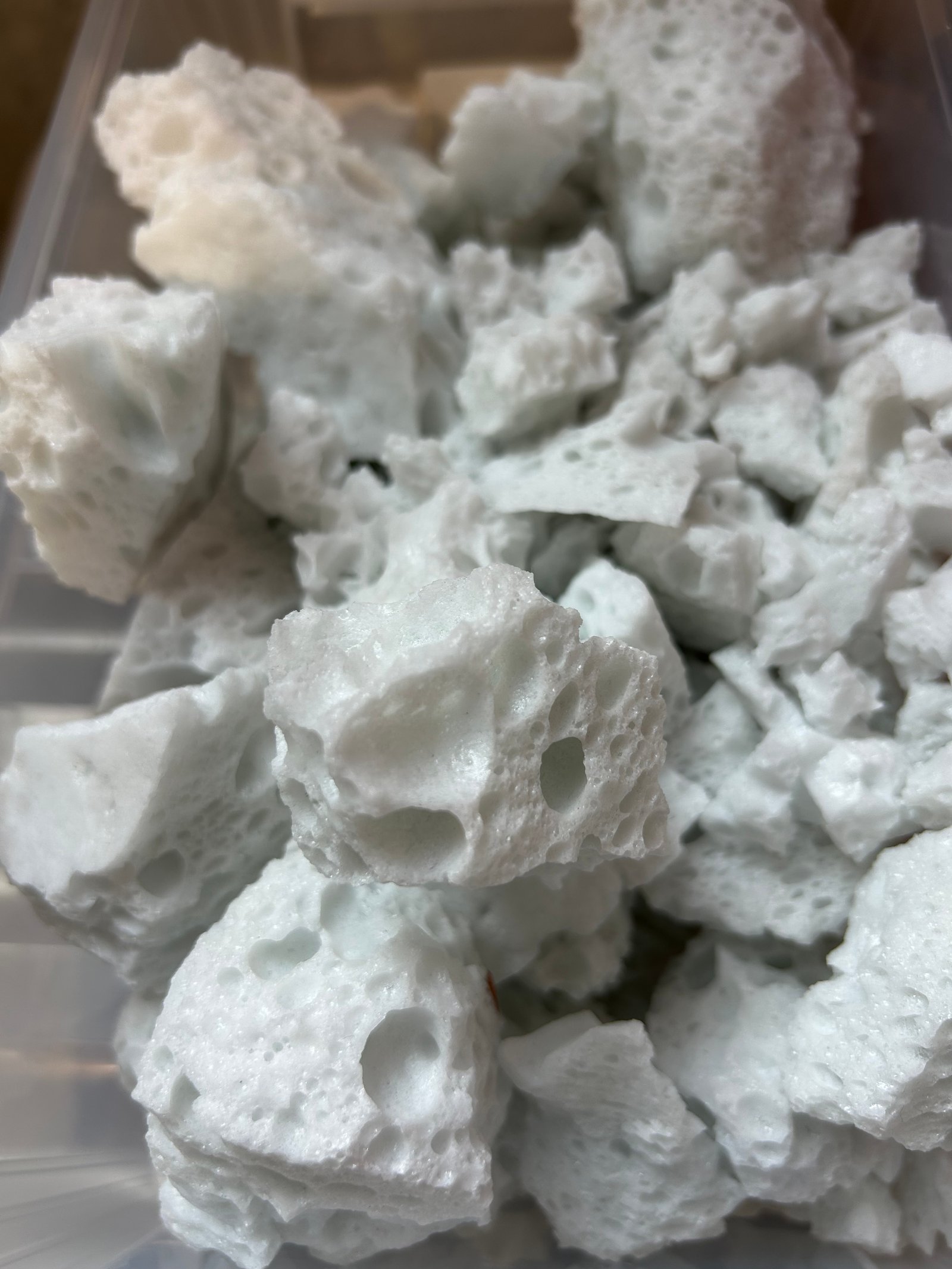
VITRIFIED SILICATE MATERIAL (VSM), THE FEEDSTOCK, BEFORE MILLING AND EXPANSION.
01, THE OPPORTUNITY
Europe needs to build with less carbon, and less virgin material.
Two forces are reshaping European construction at once, cutting the carbon embodied in buildings, and keeping materials circular by using waste instead of virgin resources. Limonite's lightweight aggregates and mineral fillers sit exactly where those two forces meet.
~2.5 bn tonnes
of aggregates are used in the EU each year, still overwhelmingly virgin-quarried.
Up to ~50%
of a new building's whole-life carbon is embodied in its materials.
Billions of tonnes
of mining tailings sit across Europe, growing as the EU scales critical-mineral production.
From 2030
EU rules phase in whole-life-carbon declarations for new buildings.
Lower carbon, circular feedstock, made in Europe, the space Limonite is built for.
02, THE TECHNOLOGY
The science of making rock rise.
Limonite starts with vitrified silicate material (VSM), mineral waste melted into a glass, and expands it into cellular spheres. The trick isn't melting; it's controlled puffing.
Essentially, a very hot, very green soufflé.
Softened mineral glass doesn't melt flat, it rises. Trapped gas puffs each grain into a strong, closed-cell sphere, and we run that expansion three ways depending on the grade: in free air, in a fluidised bed, or static on the belt. All north of 800 °C, all on renewable power. Physics does the lifting; we just set a spectacularly hot table.
01
Source & vitrify
Mineral tailings and recycling residues become a controlled silicate glass (VSM).
02
Granulate & seed
The powder is granulated around engineered cores that set the final particle size.
03
Expand
Softened glass rises as trapped gas forms closed cells, in air, fluidised, or static, north of 800 °C on renewable power.
04
Functional surface
A CO₂-reactive mineral shell is fixed to the surface, lowering embodied carbon.
CELLULAR, NOT HOLLOW
Far better strength-to-density and durability than hollow bubbles.
LOW WATER ABSORPTION
Better workability and lower admixture demand.
CO₂-REACTIVE SURFACE
Takes up CO₂ over its life, lowering embodied carbon.
CIRCULAR CHEMISTRY
Expansion agents recovered from recycling waste.
Deciding whether to study science? This is the job, taking a waste nobody wants and turning it into a material that holds up buildings, with chemistry, heat and a lot of curiosity.
03, PRODUCTS
One feedstock. Four materials, four markets.
A single upcycled feedstock is expanded across four size classes, each engineered for a distinct market, and each aimed at outperforming the incumbent it replaces. The process is also feedstock-flexible, as well as mining tailings, it can run on recycled container glass and on photovoltaic glass recovered when critical raw materials are reclaimed from end-of-life solar panels.
Cellular microspheres
Coatings, composites & high-temperature insulation, replacing hollow glass microspheres
Technical filler
High-performance mortars & mineral casting, replacing fine expanded glass
Lightweight aggregate
Precast & lightweight concrete, replacing expanded clay and glass aggregate
Geotechnical fill
Roads, embankments & infrastructure backfill, replacing foamed-glass gravel
From high-value functional fillers to high-volume infrastructure fill, one platform, four European markets.
04, THE ADVANTAGE
Engineered to outperform the incumbents.
Across the properties that decide specification, strength-to-density, water absorption, particle morphology, embodied carbon and fire performance, Limonite is engineered to shift the whole envelope rather than trade one property for another. The advantage is microstructural: a closed-cell vitreous silicate wall carries load far more efficiently than the thin shell of a hollow microsphere or the open, interconnected porosity of crushed foamed glass, so specific strength rises while water uptake and admixture demand fall. Because the base is an inorganic, amorphous silicate, the particle is non-combustible and classified Euroclass A1, and its CO₂-reactive surface carbonates over the service life, actively lowering embodied carbon rather than merely embedding it. The values below are design targets, benchmarked against typical incumbent grades, that the pilot programme is built to validate.
STRENGTH-TO-DENSITY
Leading
Expanded clay is only moderate; hollow microspheres are fragile.
WATER ABSORPTION
Low
Where foamed glass absorbs heavily.
PARTICLE SHAPE
Round and blowable
Foamed-glass gravel is angular and crushed.
FEEDSTOCK
>85% waste
Expanded clay uses virgin clay, microspheres virgin glass.
EMBODIED CARBON
Low, CO₂-reactive
Expanded clay is fired near 1,200 °C.
FIRE CLASS
A1 non-combustible
Matching the best mineral incumbents.
Design targets against typical incumbent grades.

KONGSVINGER, NORWAY
05, THE MISSION
Europe needs more minerals. Not more mine waste.
Europe is scaling up mining of the critical minerals its energy and industrial transition depends on, and that inevitably produces tailings: the fine mineral residue left once the valuable fraction is extracted. Most of it is landfilled or deposited on land and at sea. Limonite's mission is to turn that residue into a resource, vitrified and expanded into high-performance building materials, on renewable energy. Every tonne we use is a tonne that never has to be deposited: responsible mineral production and less mine waste, at the same time.
| PILOT PRODUCTION | Kongsvinger: pilot line running |
|---|---|
| BATCH & TESTING | Holmestrand: batch production and materials test centre |
| FEEDSTOCK & FUTURE PRODUCTION | West-coast Norway: close to mineral sources and hydropower |
| ENERGY | Renewable Norwegian hydropower |
| CIRCULAR CONTENT | >85% upcycled tailings |
06, CIRCULAR BY DESIGN
Two wastes in. One material out.
Most building materials follow a straight line: virgin rock is quarried and processed at high temperature, used once, then landfilled. Limonite runs that line as a loop, and the two waste streams that feed it play different roles. Mining tailings are vitrified into the silicate glass that forms the body of every particle. Residues recovered from recycling critical raw materials become the agents that expand that glass on renewable power, controlling the degree of expansion, and with it the bulk density, while governing the open porosity that determines water absorption. A single process keeps both wastes out of deposit and displaces freshly quarried rock at the same time. What comes out is not a downcycled filler but an engineered material specified on performance, with its circular credentials built in rather than bolted on.
- Mining tailings + recycling residues
- Vitrified silicate material (VSM)
- Cellular spheres with a CO₂-reactive surface
- High-performance building materials
And the material keeps taking up CO₂ over its life, a declarable, lower-carbon footprint as Europe begins to price embodied carbon.
07, JOIN THE MISSION
Build the circular materials supply chain with us.
Limonite is at an early, formative stage, the best moment to help shape it. We're looking for value-added stakeholders who want to be part of turning mine waste into high-performance, low-carbon building materials. If that's you, let's talk.
WE'D LIKE TO HEAR FROM
- Customers & specifiers, lower-carbon materials for your projects.
- Offtake & feedstock partners, mineral streams and long-term supply.
- Investors, backing the scale-up from pilot to production.
- Researchers & collaborators, pushing the materials science further.
We reply to every enquiry within a few working days.